top of page


Art & Design


Ancora 1
I was born on July 12, 1960 in Sermoneta, a splendid medieval village in central Italy not far from Rome, my family of humble origins thanks to the economic boom of the sixties gave us the opportunity to study, after high school I enrolled in the faculty of architecture of the University of Rome where I soon realized that it was not the architect I wanted to be when I grew up!
My story as a “ designer “, however, begins earlier, at the age of 11 in 1971, when my dad bought a white Fiat 128, an absolutely normal car but capable of inducing in me a passion for cars, which then became my lifelong companions.
But I wanted this great love to become my profession, this was my DREAM, but to make the dream come true I would need to attend a design school ..
There was a problem .... 50 years ago I believe there were no car design schools and there was still no internet, you had to be ready to seize the few opportunities that presented themselves, often the motor magazines organized design competitions and I won a couple, the first in the 1982 with AUTOSPRINT and the second in 1986 with Gente Motori \ Ford Europe \ GHIA, thanks to the latter I was invited to do an internship at Ford / Ghia in Turin.
Soon after I also found a job at AVIOINTERIORS as an interior designer but I wanted more, I wanted to be a Car designer!
So it was that in May 1987 I decided to come to Turin to do some interviews and show my portfolio, the first stop was at Pininfarina where I was received with great sympathy by Lorenzo Ramaciotti, Enrico Fumia, Diego Ottina and by the master Aldo Brovarone who I had way to know better in the following September while I was doing my internship.
The second important step was at Stile Bertone, I personally met a legend of car design, Nuccio Bertone, who offered me to work for them which I did starting from January 1988, I stayed for just one year because I realized that designing cars wasn't enough for me. I wanted above all to design FERRARI, so in April 1989 my adventure began in Pininfarina and ends in December 2024.
During these 34 years I have experienced exciting moments and moments of great frustration,
However, I was lucky enough to experience the extraordinary 90s, participating in the definition of many Ferrari models that are now considered true masterpieces.
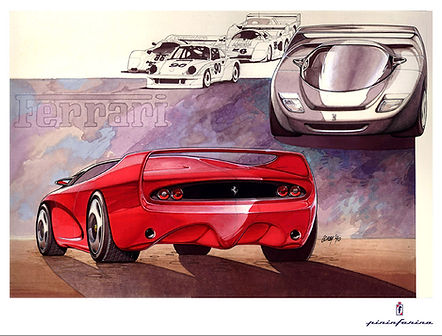
My first Ferrari project in which I took part was the 1989 F116 (F456 GT) project, from which my interior proposal was chosen. The following year, 1990, was the year of the F50, the path that led to the definition of this was quite unique because Ferrari selected different elements and parts, drawing from the proposals of the whole team, in the end Ramaciotti at the time Director of the Pininfarina Studi & Ricerche asked a colleague of mine to put together the selected areas to make a single proposal.
In 1991, Luca Cordero di Montezemolo joined the Ferrari presidency and took over from Eng. Fusaro, this was a change that had important repercussions on the continuation of our relationship with Ferrari itself.
The balance of power changed a lot, while before Pininfarina enjoyed a great ability to guide style choices with the arrival of Montezemolo things changed in the other direction, he was and still is a character with great personality and this did yes. That his requests greatly influenced the definition of the new models.
In 1992 Ferrari began to think about designing a new 8-cylinder mid-engined project F131 that went into production in 1999 as the F 360 MODENA.
In the same year they entrusted us with a heavy restyling of the F348, from the research they selected my proposals for the front and the side, thus the F355 project F129 was born.
In December of the same year I myself began the first sketches to define what later became the F550 Maranello (F131A)
The latest Ferrari I gave my contribution has been the California 2008, they selected my front end for production.
I have to admit that they have been unrepeatable years for many reasons, we all had great motivations, the projects were fascinating and we had the right time to develop them.
Furthermore, all the modeling phases proved to be an irreplaceable experience for our professional growth and at the same time the relationship that was created with the modelers was gratifying.
In the early 2000s, new tools appeared for our work, one of these, today irreplaceable, Photoshop.
Goodbye to paper and markers ... the digital age began, no more drawings to be pasted but pixels to print.
Even the entire design process changed radically thanks to the introduction of modeling programs such as Alias, all this if on the one hand added value to our work on the other made us lose that aura of romanticism that enveloped it.
Perhaps this is precisely one of the reasons that prompted me in my free time to illustrate the wonderful cars of the past, alternating illustration techniques ranging from markers on paper to acrylics on canvas.
When I start a new artwork, for me it is like accepting a new challenge, in search of an almost maniacal definition of detail. Basically it is a hyper-realistic technique with the intent, however, of not falling into cold photorealism.
The journey continues….
Maurizio Corbi
Ancora 2
CAR DESIGN
Images courtesy of Pininfarina S.p.A




AUTOMOTIVE ART
originals/prints available


AWARDS

lectures


magazine
Ancora 4
CONTACT ME
bottom of page